
I have always loved writing. As a teenager, I wrote poems, short stories and songs. When I moved to France, married a German and started working in English, the daily mixture of languages made me lose confidence in my capacity to write in Spanish as I used to. For almost thirty years, my creative writing focused on speeches, campaigns, leaflets, articles, reports and strategies. During the COVID lockdown, I decided to try fiction again and, much to my surprise, it worked! Receiving the first prize at a writing contest in 2022 for my “Butterfly People” novel made me gain confidence and marked my return to writing fiction. A childhood dream came to life with the publication in September 2023 of “Nudos” (“Knots”), an illustrated album for children.
In this section, I present some of my publications. I am very bad at keeping track, but I have included articles about children’s rights and sport policies, as well as short fiction stories and illustrated children’s books.
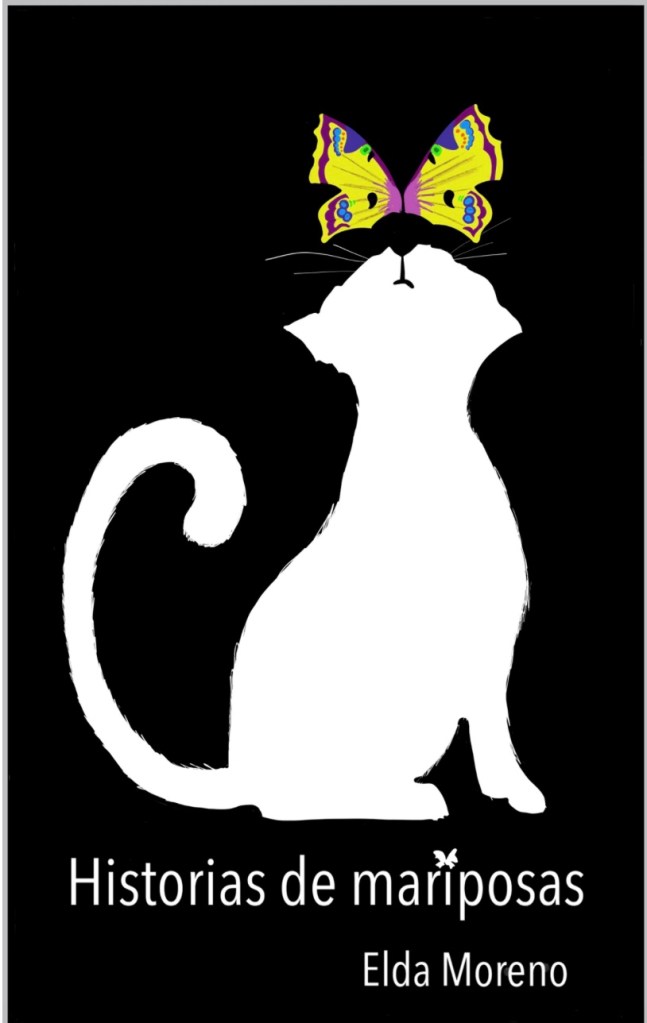
Butterfly People
Available in Spanish and English on paperback and Kindle format, this one-hour read of magical realism reflects on our attitude towards change. It also raises awareness on the challenges that the elderly face and the abuse going on in many nursing homes. It was awarded a first prize in a literary context and published by the city of Castellon (Spain). To make it more easily available, I have translated it into English and self-published both versions in Amazon.
The plot: Marina is 85 years old but, according to her granddaughter Rocío, she is playing to be five. Marlene has no other option than to place Marina in a nursing home. As she empties her mother’s flat, she hopes to find the missing pieces of her own life’s puzzle. At the nursing home, young nurse Mercedes tries to protect the elderly from neglect and abuse and will find in ten- year-old Rocío an unexpected ally. Butterfly people is about our attitude towards change. It is also about secrets that only cats know.

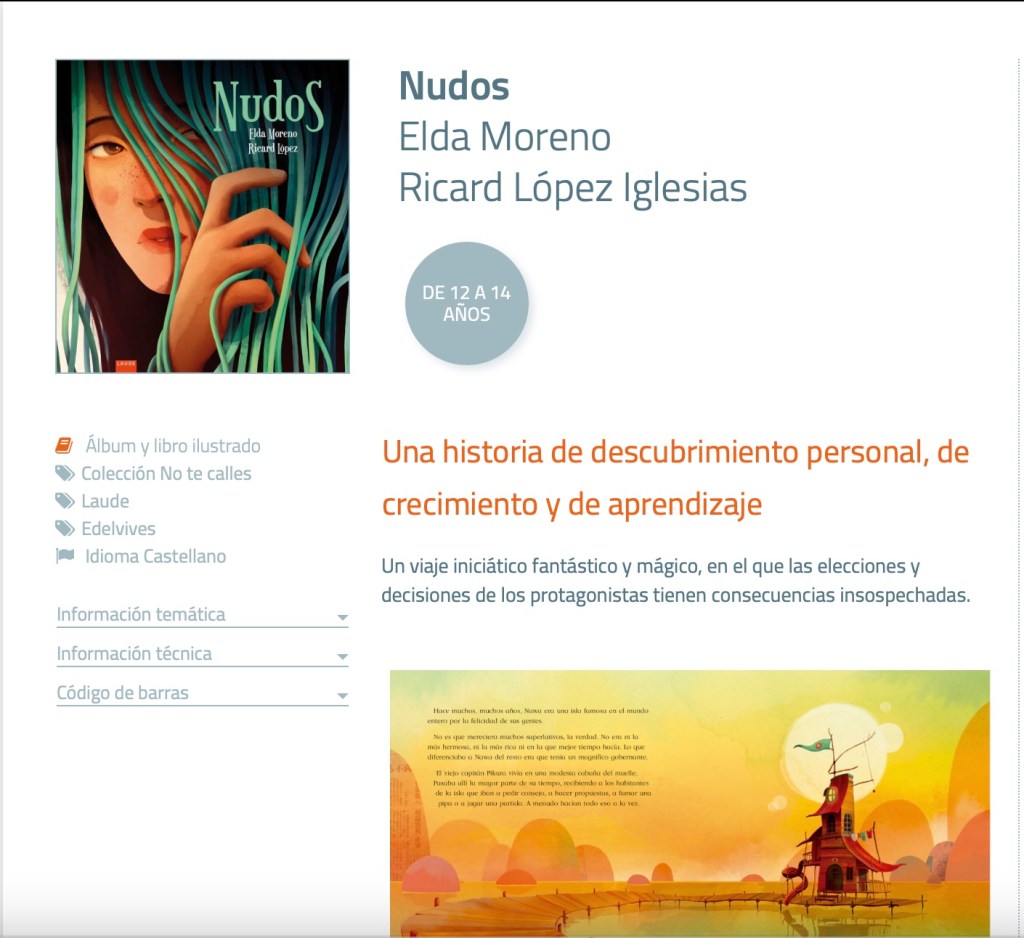
Nudos (Knots)
Published in September 2023 by Edelvives, “Nudos” (or Knots in English) is a book for children illustrated by the very talented Ricard Lopez Iglesias. It is about the exercise of power, the choices we make in life, our priorities and the things and wishes that tie us. The main character is Aremi, an adolescent girl adopted by the governor of a small island famous because of its people’s happiness. I wrote Nudos in Spanish but has been published in French by Hachette under the title “Le voyage d’Arémi“. The book keeps touring international book fairs and I hope it will be soon available in other languages.




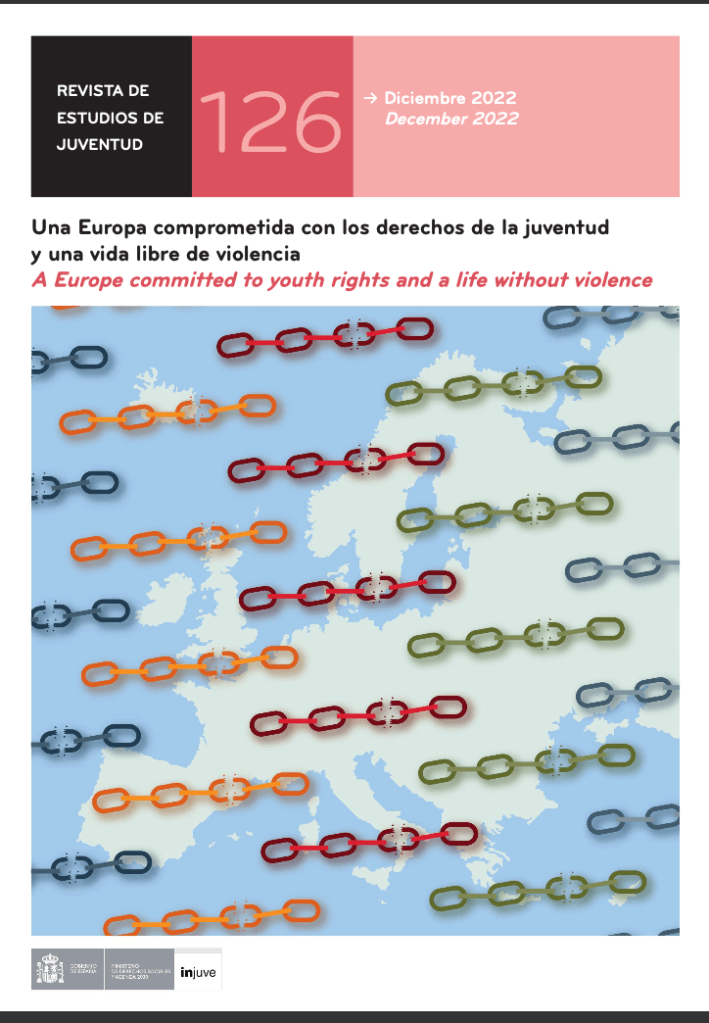
A Europe committed to youth rights and a life without violence
Published in 2022, this article appears in the issue 126 of the Youth Studies INJUVE magazine “A Europe devoted to Youth Rights and a life without violence”. My contribution discusses the challenges that children and youth experience in the exercise of their human rights. Despite having much in common, children and youth policies seem to develop in parallel universes. I highlight the interest of establishing gateways to advance both agendas at local, national and international level. The English version appears in pages 208-225. La versión española del artículo se puede consultar en las páginas 89 a 106.
The European Convention of Human Rights and the rights of the Child
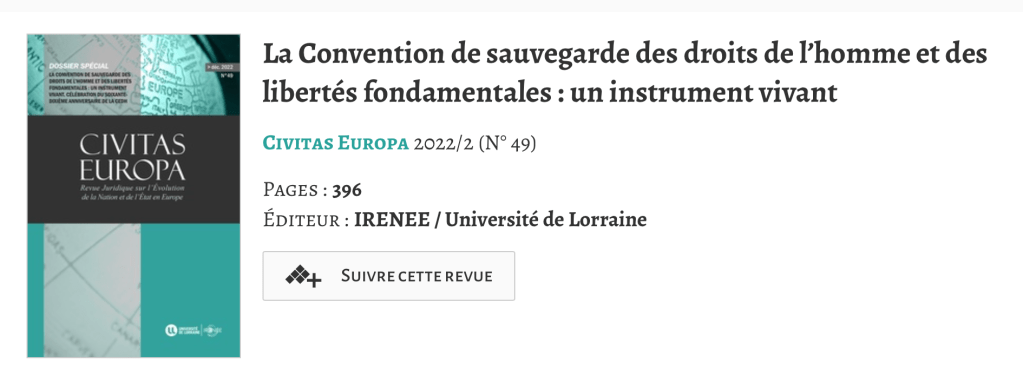
This is an article published in French in the magazine CIVITAS EUROPA 2022/2, pages 203-209. I discuss the interplay between the European Convention on Human Rights (ECHR) and Council of Europe standards and policies on the rights of the child. The text of the European Convention on Human Rights (ECHR) only refers to children (minors) twice. This notable absence is most likely due to the historic context in which the treaty was drafted. In fact, children had to wait almost forty years for “their UN Convention” and over sixty for their own complaints mechanism. Adopted in 1989, the United Nations Convention on the Rights of the Child represents a paradigm shift: the child is finally treated as a rights’ holder, and not only as an object of charity or protection.
Launched in 2006, the Council of Europe programme “Building a Europe for and with children” was designed to address the child’s invisibility by placing the ECHR and the case law developed by its Court as tools to promote compliance with children’s rights. The ECHR and its case law thus inspired a series of innovative treaties and recommendations by the Committee of Ministers of the Council of Europe which are now global references and which, in turn, help the Court to set out its reasoning regarding children. These are standards that define the boundaries of child protection against sexual violence, trafficking, domestic violence, or which identify the principles and components of a child friendly justice system. Under this spotlight, the rights of the child have become a priority for the Council of Europe and its Member States. Although the advancements in the protection of children’s rights and their place in the Court’s case law should be applauded, it is difficult to be satisfied with the current situation. More and more children are turning to international institutions to denounce the violations of their rights, but it is not enough. In order for more children to be able to invoke the ECHR and refer to the Court, there are many more obstacles to overcome. The lack of access to information on their rights, the lack of counsel and support in procedures at national level and the risk of retaliation are real obstacles, which are unsurmountable for children in particularly vulnerable situations. There is an urgency to promote specific services capable of receiving children’s actions and child protective measures at national level to ensure justice is done at this level. Although the increase in cases brought by children to the Court is encouraging and is clearly advancing their cause, for children to truly conquer the ECHR, implementation must be assured first and foremost at national level.
Building Human Rights in Strasbourg- The child as a human rights holder and an agent of social change
Article included in a book published by Tirant Lo Blanch in 2020 celebrating sixty years of the European Convention of Human Rights. Only available in Spanish, original title of the book “Construyendo los derechos humanos en Estrasburgo”.
Break the silence around sexual violence against children in sport
Contribution to the XIV International Congress on violence against children organised by FAPMI in 2018. Only available in Spanish, the text presents the challenges and the specificities of sexual violence against children in sport and proposes strategies to efficiently prevent it and respond to it, in particular through the development of safeguarding policies which engage all actors in the sport ecosystem, including children and their families. It also showcases the Council of Europe campaign “Start to talk”.
The fight against sexual violence in Europe: a journey towards and efficient and coordinated action
This article was published in 2018 by the Ararteko (Basque Country ombudsman) in Spanish and Basque (Euskara) languages. In the text, I describe ending sexual violence against children as a journey starting in denial and ignorance, and heading towards an integrated, efficient and coordinated action. After identifying the main reasons why sexual violence remains prevalent and poorly addressed, I advocate for strategies that are based on the rights of the child, that seek to understand and explain the complexity of the issue (through research, education, training and awareness raising), that clearly identify roles and responsibilities and that ensure a broad mobilisation and an efficient coordination of all relevant stakeholders.

Childhood and positive parenting policies within the European framework
Published by Papeles Salmantinos de Educación in 2010, this article available only in Spanish describes the concept of “positive parenting” developed by the Council of Europe and its interest for the protection of the rights of the child, in particular the prevention of some forms of violence against children such as corporal punishment.
 eldamoreno.com